

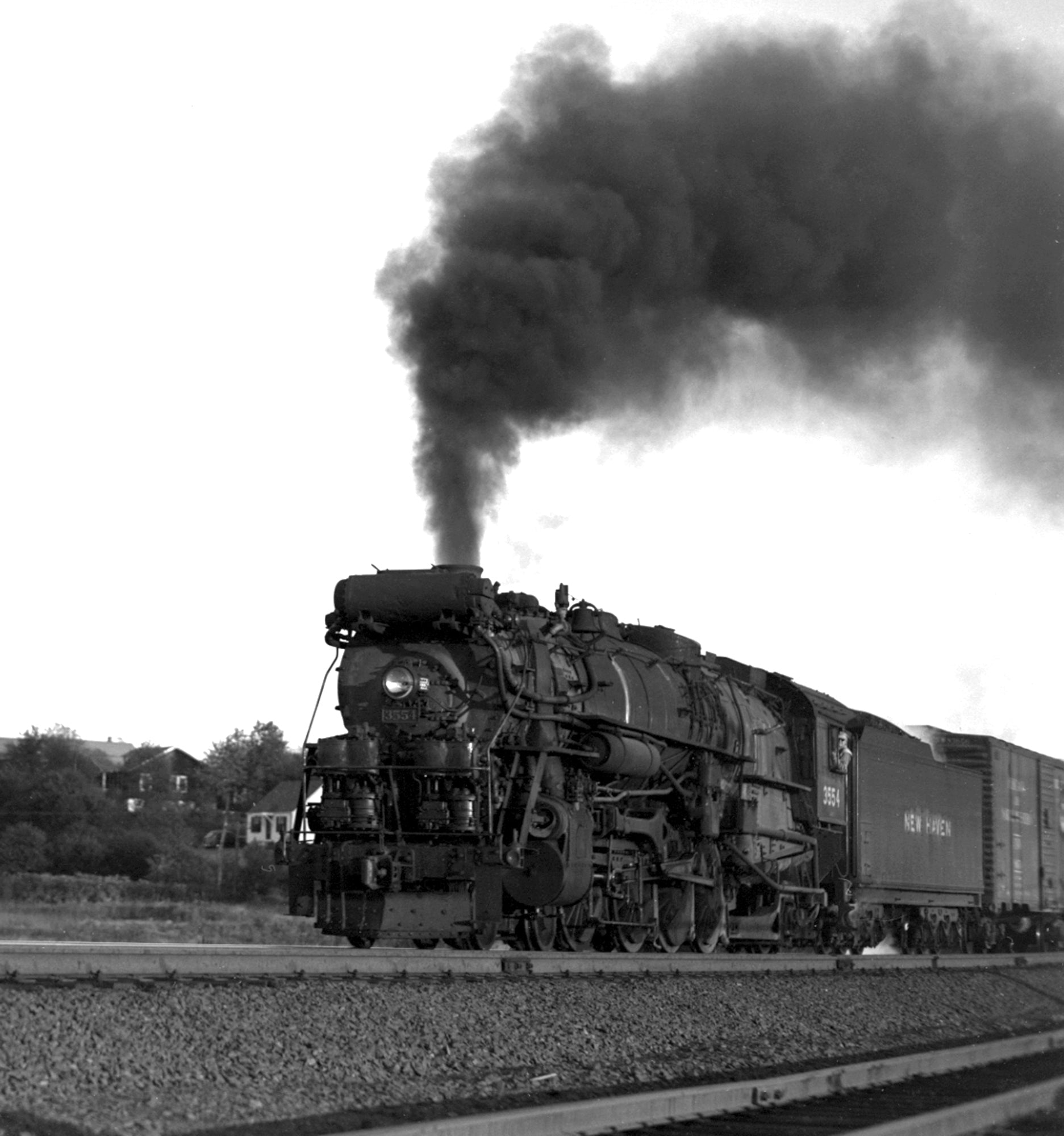
About The Prototype: The New Haven R3a!
Welcome to BLI's new blog series, About the Prototype! This series is dedicated to exploring the real-life railroad equipment that our upcoming BLI models are based on, offering historical background, operational context, and insights from knowledgeable members of the railroad and modeling communities. In each installment, we take a closer look at the prototype locomotives and rolling stock behind our releases, helping bring their stories to life beyond the model itself.
Information for this installment has been provided by John Sheridan of the New Haven Railroad Technical and Historical Association. Photos in this post are provided by the collection of Harry Lange.

PHOTO: The crew members of locomotive 3562 pose for a photo. Photo courtesy of Harry R. Lange.
The New Haven Railroad's introduction to Mountain type locomotives began in 1919 with acquisitions based on USRA designs. These early locomotives entered freight service on the Shore Line between Boston and New Haven, a corridor that had previously relied on 2-8-2 Class J Mikados and Class L Santa Fe 2-10-2 type locomotives for its freight operations.
 PHOTO: Locomotive 3562 is seen switching. Photo courtesy of Harry R. Lange.
The New Haven R3 was a class of thirteen locomotives built by the American Locomotive Company (ALCO) in Schenectady, New York, between 1926 and 1928. Refined from the earlier R1 and R2 classes, the R3s were the largest and heaviest steam locomotives on the New Haven's roster and were most commonly found in heavy freight service.
What set the R3s apart from virtually every other steam locomotive in North America was their use of three cylinders rather than the typical two. The third cylinder was located centrally beneath the smokebox and utilized Gresley's conjugated valve gear. The locomotives also featured a feedwater heater on the boiler.
PHOTO: Locomotive 3552 is seen in New London, Connecticut on June 6th, 1948. Photo courtesy of Harry R. Lange.
Upon delivery, the R3s quickly proved themselves. Engineers found they could haul 100 loaded cars at near passenger train speeds, and the locomotives were rated for the same tonnages as the Class L 2-10-2s while having one fewer pair of drivers and considerably more speed. The R3s even surpassed the Pennsylvania Railroad's M1a Mountains in power, despite the M1a being 11,000 lbs. heavier and having 3-inch taller drivers.
The three-cylinder configuration brought several notable performance advantages. The locomotives could pull heavy trains more easily than their two-cylinder counterparts, accelerate faster, and ride more smoothly. The R3s were capable of hauling up to 5,000 tons, a significant improvement over the earlier R2s, which were rated for approximately 3,500 tons. They were also commonly equipped with Nathan 5-chime whistles.

PHOTO: Locomotive 3552 is seen hauling a mixed freight on June 7th, 1948. Photo courtesy of Harry R. Lange
Despite their impressive capabilities, the R3s were not without their difficulties. The central third cylinder was hard to access during maintenance, a problem compounded by the air pumps mounted at the front of the locomotive above the pilot, which further restricted crew access. These mechanical challenges were an ongoing reality throughout the locomotives' service lives, yet the R3s continued to operate in revenue service despite them.

PHOTO: In this 3D render of locomotive 3556, this model depicts the R3a's during their 1928 to 1939 appearance.
Broadway Limited Imports is proud to bring this remarkable prototype to HO scale. This all-new, newly tooled model combines museum-quality brass construction with modern operating performance, capturing the unmistakable character of New Haven steam at its peak. With its bold proportions and highly distinctive front-end design, the R3a stands out immediately — whether leading a heavy freight consist or displayed as a centerpiece locomotive.

PHOTO: From 1940-1945, the locomotives had a protective shield placed in front of the air pumps. and location changes of several pipework on the boiler and smokebox.
This first production run includes multiple road numbers, each rendered with era-appropriate and road-specific detailing. Careful attention has been paid to the R3a's unique external features, especially the distinctive front-end appliances and proportions that set it apart from more common 4-8-2 designs.

PHOTO: Our third type of this model features the locomotive in it's appearance from 1945 to 1950.
Even for modelers without a New Haven-specific layout, the R3a offers a rare opportunity to roster a steam locomotive that is visually compelling, historically significant, and seldom modeled in HO scale.
The order deadline is December 10th, 2026. Please contact your favorite dealer to place your order! Click here to find a dealer near you!
Read more

The Broadway Flyer: April 2026
Click here to read the April edition of The Broadway Flyer!
Read more
About The Prototype: The Santa Fe 2926!
Welcome to BLI's new blog series, About the Prototype! This series is dedicated to exploring the real-life railroad equipment that our upcoming BLI models are based on, offering historical backgrou...
Read more
1 comment
Thank you for crediting my Father Harry R. Lange for the photos. I scanned a bunch of his 4X5 negatives and have more photos available if needed. I also preordered one of the HO models as that is one of my favorite New Haven locomotives. Would like to order another one but may not have the money for it.
Charles R Lange
Leave a comment
This site is protected by hCaptcha and the hCaptcha Privacy Policy and Terms of Service apply.