

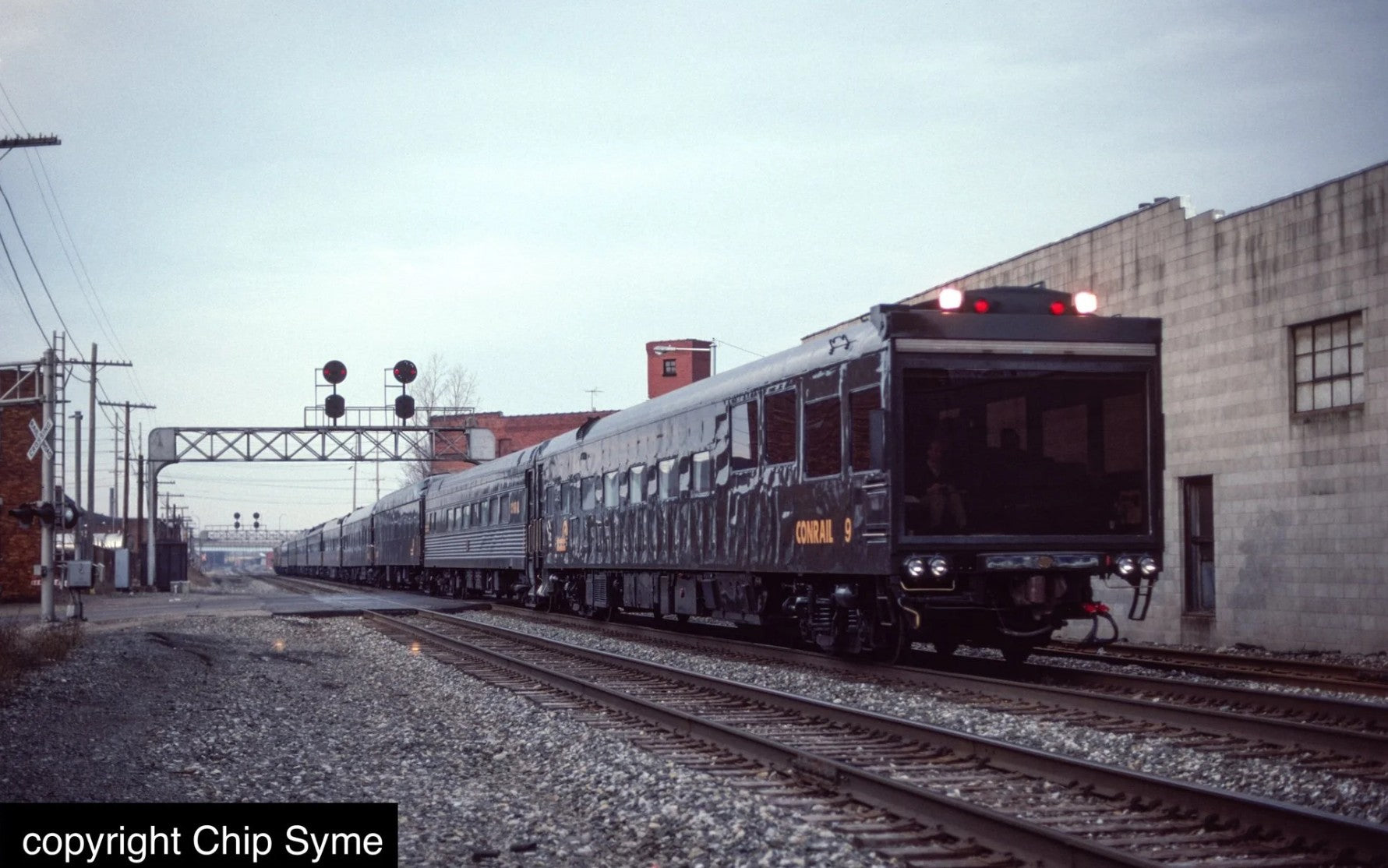
About The Prototype: Conrail #9 / CSX "W. Thomas Rice"
Welcome to BLI’s new blog series, About the Prototype! This series is dedicated to exploring the real-life railroad equipment that our upcoming BLI models are based on, offering historical background, operational context, and insights from knowledgeable members of the railroad and modeling communities.
In each installment, we take a closer look at the prototype locomotives and rolling stock behind our releases, helping bring their stories to life beyond the model itself.
Today’s feature focuses on Conrail No. 9, later renumbered and operated by CSX as the “W. Thomas Rice.” The article is written by Wes Reminder, creator of conrailocs.com, who shares his expertise on the history and significance of this unique piece of railroad equipment.
We at BLI are excited to collaborate with both Wes Reminder and the members of the Conrail Historical Society on these projects. To learn more about these offerings, be sure to visit our website—and don’t forget to place your pre-order through your preferred dealer to secure yours! The order deadline is August 6th, 2026.
WES REMINDER - As the Conrail business train came speeding down the rails, cameras snapped the approaching Conrail E8As and quickly turned to catch Conrail 9 (the theater inspection car) disappear into the distance. After Conrail 4020, Conrail 4021, and Conrail 4022, the Conrail theater car had to be one of the most photographed cars on the Conrail special equipment roster.
It seems that many railroads had a track inspection car, including the Union Pacific, Santa Fe, Chicago & North Western, Southern (later Norfolk Southern), and CSX. Their purpose was all the same: a way for railroad officials to see the physical railroad as the train toured the region. Before we get into the Conrail theater car, let’s take a quick look at some of the other railroad inspection cars. As you read through, keep in mind that many of the cars have essentially the same setup.
• Built in 1949 as sleeper “Western Mountain”
• Rebuilt as a UP inspection car “Idaho”
• Features end picture window, tiered theater seats, dining area, kitchen, restrooms

• Built in 1954 as a buffet-lounge-sleeper for Canadian National Railway
• Purchased by Milwaukee Rail Car and converted to an inspection car
• Purchased by Chicago & North Western in 1985 and acquired by UP in 1995
• Features end picture window, tiered theater seats, dining area, kitchen, restrooms
Santa Fe “Track Inspection Car” ATSF 89

• Built in 1940 as a Club-Lounge
• Rebuilt as Track Inspection Car ATSF 89 in 1975
• Acquired by BNSF in the merger and is now BNSF 32 “William B. Strong”
• Features end picture window, tiered theater seats, lounge area, small kitchen area, restroom
• Built in 1918 as sleeper lounge “Cuyama”
• Southern rebuilt it into inspection car “Buena Vista” SOU 19 in 1973
• Norfolk Southern numbered it NS 23 in 1985
• Features end picture window, tiered theater seats, dining area, kitchen, restroom

• Built in 1953 as a 58-seat coach
• Rebuilt in 1993 as inspection car “Georgia” CSXT 994318
• Features end picture window, tiered theater seats, dining area, kitchen, restroom
The common layout of the inspection car was a large picture window, tiered seats, an area to eat or lounge, a kitchen, and restrooms. Conrail 9 was no exception to the theater car rule and features the same general layout.
Lets take a look at Conrail 9’s history:
- CSX 994009 “W Thomas Rice” (2020)
- CSX 994009 “Alabama” (2006)
- CSX 994009 “Massachusetts” - (6/1/99)
- Conrail 9 - (3/31/85)
- Conrail 23 - (12/20/82)
- VIA 428 - (77)
- Canadian National 428 -(54)
Conrail 9, like the Union Pacific “Fox River”, started its career in 1954 and was built Pullman-Standard for the Canadian National Railway. According to Conrail documentation “the car was originally built as dinette car 428, class DLC-82-A. No. 428 served primarily as a supplement to full dining cars on trains like the “The Super Continental”, “Ocean Limited”, and “Scotian” as well as the meal service car on secondary trains like the “Maple Leaf”. Conveyed to VIA Railway in 1977 and renumbered VIA 428 where it was used as a versatile food service car well into the 1980s.”
Conrail documentation also states that “Conrail bought the car in 1982 and renumbered it CR 23 for purposes of clearing U.S. Customs.” The talented Conrail Reading passenger car shops converted the car to a theater track inspection car numbered Conrail 9 and released it for service in March 1985 (painted in dark green - roof to rails). The Conrail 9 officially joined the Office Car Special fleet and its fame was secured, bringing up the markers on Conrail business car movements until the Conrail takeover in 1999.

PHOTO: Conrail 9 on OCS-402 in Canton, Ohio. This photo was taken in January 1998. Photo courtesy of Chip Syme.
Conrail 9 featured two large engines on the underbody simply labelled “Engine No. I” and “Engine No. II” that powered not only the Conrail 9, but also another car connected to it. It was most commonly coupled to Conrail Conference Car 12, but could also be found coupled to other Conrail office cars, like Conrail 8 and Conrail 10. With two large engines capable of powering itself and another car, this required two fuel tanks located directly behind the engines, followed by battery boxes. Other underbody equipment included air compressors, engine refrigeration, water fill, propane tanks for the kitchen, treatment tanks, and the air conditioner.

PHOTO: Taking a look at Engine No. II on Conrail #9. Photo Courtesy of Wes Reminder.
Conrail 9 also had two small service doors for loading food and supplies. On the hallway side, the service door can be seen in front of the gold Conrail logo and across from the kitchen door. On the kitchen side, the service door was in the kitchen between the charbroil and freezer. As Conrail 9 was often used by the chefs, I’m sure this made loading the food much easier.

PHOTO: A closer look at Conrail #9's large window. Photo courtesy of Wes Reminder.
The large picture window on the end was tinted at some point in its time on Conrail (maybe to provide some privacy for the Conrail executives and hide their puzzled or annoyed faces when viewing the railfans). Normal operation was for the large picture window to face the rear of the train. When Conrail 9’s large window was coupled facing forward near one of the E8s, a large roll down metal gate was lowered to protect the glass from any debris that might be kicked up.

PHOTO: A look at the control panel that housed the radio, emergency brake valve and other equipment. Photo courtesy of Wes Reminder.
On the inside theater seating area near the large window, there was a control panel on the kitchen side of the car that featured a radio for talking to the head end, an emergency brake valve, light controls for the three sets of exterior lights (2 red FRA approved translite markers, 2 upper flood lights, and 2 lower headlights with 2 bulbs each), and a button to blow the horn. That’s right, the Conrail 9 has a horn. It sounded more like the horns used on MOW equipment than the melody of a Leslie RSL-3L-R horn like the E8As had. Photo courtesy of Wes Reminder.
Conrail 9’s theater seats also featured fold down trays for the riders to place their trip booklets and other various things. Above the picture window, and like many of the other office cars, there were gauges for the outside temperature, a beautiful Boston clock, speedometer, brake pipe pressure gauge, and inside temperature gauge. These were illuminated from hanging lights. Remember, we are talking the 1990s here, so no digital displays like those that can be found on updated business cars.

PHOTO: A look at the dining area of Conrail #9 with a peak towards the theater style seating. Photo courtesy of Wes Reminder.
Other interior features included arrangeable dining tables, cabinetry with a constant flow of coffee and juice, and a small sink. Conrail 9 had a full service stainless kitchen and a restroom. The decor when I visited Conrail 9 was very 1990s (it didn’t look dated then!) and I am sure CSX has updated it by this point. Conrail photographs of the Conrail OCS train adorned the wall separating the kitchen from the dining room. A small serving window that opened and closed was also on that wall allowing quick service of food. Don Oltmann has a fantastic blog post discussing the springs and ventilation fans in Conrail 9. I think I’ve read it, I don’t know, many a hundred times! Love those kinds of stories.
After Conrail was split between CSX and Norfolk Southern, Conrail 9 became part of the CSX Transportation fleet. It was quickly repainted in CSX YN2 colors and given the name Massachusetts. When CSX repainted its business cars in YN3 colors, the car lost its Northeastern name and was renamed Alabama in 2006.
CSX’s Waycross Coach Shop updated the car in 2006, with additional work to the roll-up door and roof completed around 2008–2009. In 2013, the West Jacksonville Business Car Facility upgraded the interior. During this rebuild, the kitchen—originally designed with input from Conrail chef Ted Nelson—was removed in favor of a small conference room with a table and four chairs. Because the space was tight, it was later converted into a locker room, with individual doors labeled with the names of CSX executives and a bench in the center featuring the CSX logo.

PHOTO: The locker room of CSX "W.Thomas Rice". Photo courtesy of Wes Reminder.
Cabinets at the end of the seating area remain, including the sink inside one of them. The last row of seats, where L. Stanley Crane often sat, was removed and replaced with two plush ‘captain’s chairs.’ All theater area seats have been updated. The rear of the dining area now features a serving bar with the CSX logo; the original serving window from the kitchen is no longer present.

PHOTO: The Executive Chair in CSX 994009. Photo courtesy of Wes Reminder.

PHOTO: The theater seats in CSX 994009. Photo courtesy of Wes Reminder.
For a time, I wondered if the former Conrail 9 had been sold along with former Conrail 12 and former Conrail 8, but photos and video as recent as 2019 confirmed it was still in service. Today, CSX 994009 is the preferred OCS theater car, while CSX 994318, Prime F. Osborn III, serves as a secondary theater car.

PHOTO: CSX "W. Thomas Rice" sits at Washington Union Station on December 2nd, 2025. Photo courtesy of Wes Reminder.
In 2020, the CSX Business Train received a full repaint inspired by the iconic Baltimore and Ohio Railroad (B&O) colors. By September 2020, Conrail 9 was repainted and renamed "W. Thomas Rice", honoring the pivotal railroad executive who helped form CSX in 1980. CSX also moved its business car fleet indoors at the Waycross Shops in Georgia, where the interior and exterior of the car remain in excellent condition, retaining the general configuration of Conrail 9.
Conrail 9 has a fascinating history, and Brock Kerchner and I are delighted to collaborate with Broadway Limited to bring this iconic car to life. If you own the Union Pacific theater cars produced earlier this year, you can anticipate that the Conrail and CSX theater cars will be an accurate and exciting addition to your HO scale office car collection.
Read more
The Broadway Flyer: March 2026
To view the March 2026 edition of The Broadway Flyer, click here.
Read more
The Broadway Flyer: April 2026
Click here to read the April edition of The Broadway Flyer!
Read more
2 comments
I hope you do Conrail OCS car 9 in N Scale. I was lucky enough to be the engineer for Conrail OCS several times. I have the OCS train in N Scale would love to have car 9.
Todd Treaster
Please produce a Southern Pacific version (present day w / Red Letterboard bordered by black pinstripes… “Salton Sea” a play on words…
Michael J Baldini
Leave a comment
This site is protected by hCaptcha and the hCaptcha Privacy Policy and Terms of Service apply.